Buyers and procurement officers in the West Midlands were the lowest paid in the country for their profession in 2024. By 2025, they were second only to London. The shift reflects something structural happening to the region's labour market.
Few job titles sound less exciting than "buyer and procurement officer." But the pay data for this occupation in 2025 tells an unexpectedly sharp story about what the transition to electric vehicles is doing to the West Midlands workforce.
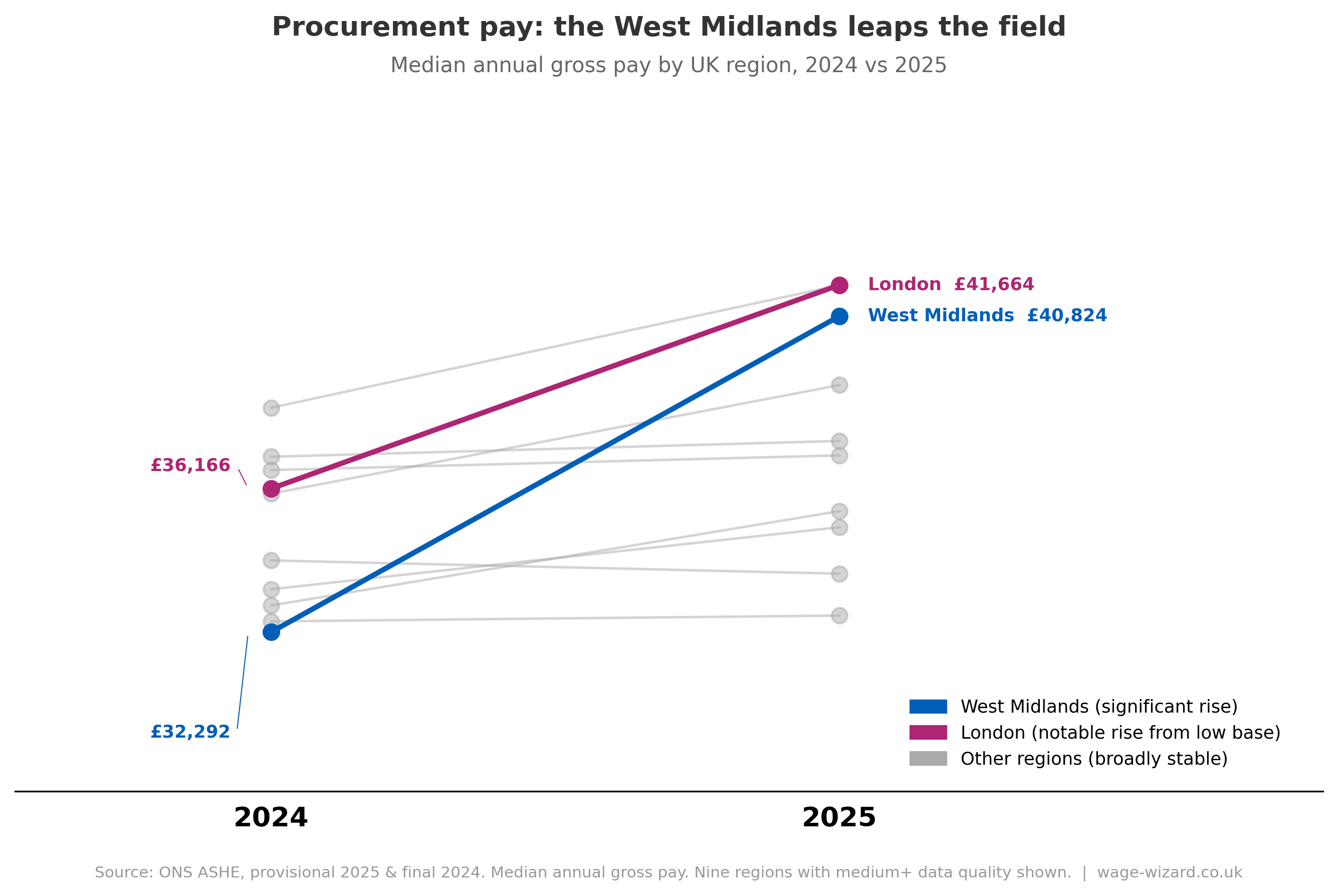
Median annual pay for procurement professionals in the West Midlands rose from £32,292 to £40,824 between 2024 and 2025, an increase of 26%. Most other regions saw increases of 1-9% or stayed flat. Scotland and the North West barely moved.
A region built on supply chains
The West Midlands accounts for around 32% of UK automotive employment and is home to JLR, Stellantis, and a dense network of tier-1 and tier-2 suppliers. For decades that concentration made the region a natural home for procurement professionals who understood how automotive supply chains worked.
The shift to electric vehicles is changing the skills that concentration demands. New supply chains for battery materials, power electronics, and new categories of component require procurement professionals who can manage entirely different supplier relationships, often with overseas partners, and across materials with volatile pricing. That kind of specialist capability is in short supply nationally — and disproportionately in demand in the West Midlands.
Public investment is amplifying that demand. A £12.5m Supply Chain Transition Programme launched in 2025 specifically targets diversification into EV, battery, aerospace, and medtech supply chains. A £15m manufacturing transformation fund is also active. Regional manufacturing output is already more than 10% above 2019 levels, with 9,000 jobs added since 2023.
From lowest to near the top
In 2024, a procurement professional in the West Midlands earned roughly £4,000 less per year than one in London and around £5,000 less than one in the East Midlands. By 2025, the West Midlands had overtaken the East Midlands entirely and was within £800 of London's median.
That kind of catch-up from a low base does not happen through routine salary reviews. It requires genuine demand pressure: employers competing for a limited pool of people with the right skills, in a region where those skills are suddenly more valuable than they used to be.
Reed's 2025 procurement salary guide specifically identifies the West Midlands as one of the regions where procurement and supply chain salaries have increased the most, attributing it to the strong performance of transport and logistics firms — which in this region means, in practice, the automotive transition.
Why other regions stayed flat
London and the South East were already high-cost environments for procurement talent, so additional demand produces smaller percentage moves. Yorkshire, Scotland, and the North West have less manufacturing concentration and fewer large-scale EV transition anchors in their supplier base. There is no equivalent structural driver pushing procurement pay sharply upward in those regions right now.
Explore pay for procurement professionals and hundreds of other occupations across every UK region at Wage Wizard.