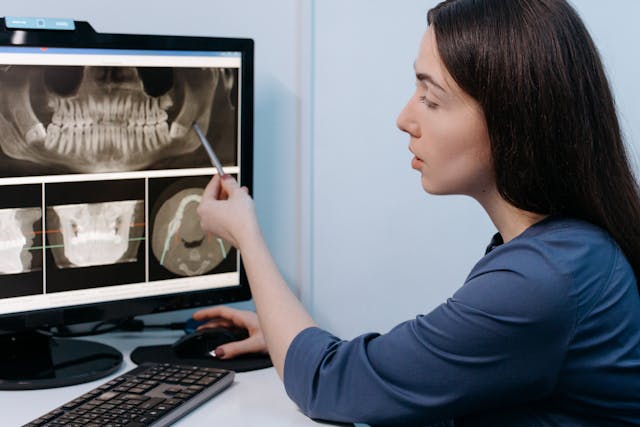
The same occupation, the same national pay scale, but very different regional stories. New data from Wage Wizard reveals what's really happening to radiographer pay across the UK.
NHS radiographers work to a national pay scale. Agenda for Change rates are set centrally, apply uniformly across England, and moved by 5.5% in 2024-25. So why does the latest ONS earnings data show median annual pay for radiographers rising by 25% in the West Midlands while falling by 11% in London?
The answer tells you more about how the NHS is managing a workforce crisis than about pay rises but it is a genuinely important story about what is happening to radiography services across the country.
The West Midlands: a diagnostic centre building boom
The West Midlands has seen one of the most intensive expansions of Community Diagnostic Centres anywhere in England. Birmingham's first CDC opened in 2024 at Washwood Heath; a North Solihull centre followed in spring 2025; a South Birmingham centre was announced for summer 2025. The West Midlands Imaging Network now spans 15 NHS trusts serving 6.7 million patients, and Midlands CDCs have collectively delivered nearly 1.5 million diagnostic tests since mid-2024.
Building that capacity quickly, in a profession with a 13% national vacancy rate, means competing hard for experienced staff. CDCs disproportionately recruit Band 6 and Band 7 radiographers: the senior practitioners who can work more independently and handle the volume these facilities are designed to deliver. In 2024, the West Midlands ASHE sample for this occupation was weighted toward entry-level and mid-grade workers. By 2025, a significant cohort of more senior, higher-paid staff had joined the regional workforce.
The result: median annual pay moving from £34,788 to £43,629 not because anyone received a 25% pay rise, but because the composition of who is working in the region shifted sharply upward in seniority.
That is a meaningful distinction. But it is also a real signal: the West Midlands is now a materially different labour market for experienced radiographers than it was twelve months ago.
London: the agency crackdown bites
London's story runs in the opposite direction and has a different structural cause.
In 2024, London's median radiographer pay of £53,944 sat well above the Agenda for Change Band 7 maximum of around £48,000. That premium reflects the high proportion of agency and bank staff captured in the London ASHE sample radiographers working at rates that can reach two to three times standard NHS pay. London NHS trusts, under persistent staffing pressure, had been among the heaviest users of temporary radiology staff.
In late 2024, that changed. The Health Secretary mandated a system-wide freeze on agency spending; NHS England cut total agency spend by nearly £1 billion in 2024-25, a reduction of around 30%. Radiology where the NHS had been spending an estimated £325 million per year on temporary staff, up 24% year-on-year was a prime target.
By April 2025, when ASHE data is collected, the high-pay agency cohort that had inflated London's median was significantly smaller. The median fell to £47,855, much closer to the standard AfC Band 6-7 range, not because any radiographer took a pay cut, but because fewer high-cost temporary workers were captured in the data.
What the data actually shows
The chart below shows median annual pay for medical radiographers by region in 2024 and 2025, for the eight regions with sufficient data quality to report reliably.
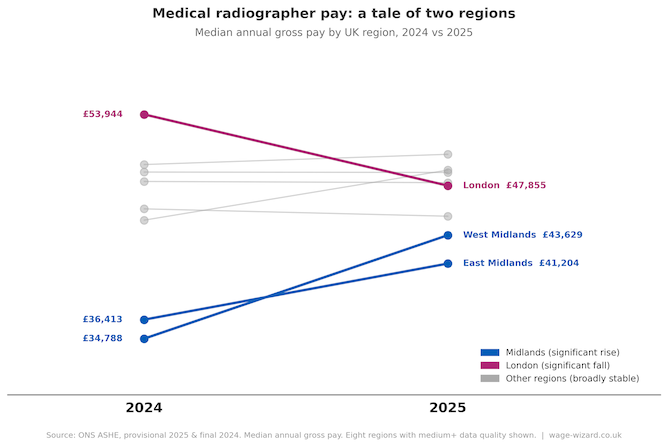
The broad picture is one of convergence: the two lowest-paid regions in 2024 (West Midlands, £34,788; East Midlands, £36,413) have moved significantly toward the national centre of gravity. The outlier at the top (London, £53,944) has come down. Most other regions remained broadly stable.
What this means for radiographers and patients
For radiographers, the regional picture has become more equal but also more complex. The West Midlands is clearly hiring, and hiring at senior grades: it is potentially a good moment to be an experienced practitioner in that market. London's apparent pay premium has narrowed considerably, though this reflects a reduction in lucrative agency work rather than a change in permanent salaries.
For patients, the CDC expansion in the West Midlands represents a genuine step-change in imaging capacity. The question is whether the workforce to sustain it is there: with a 13% national vacancy rate and an agency crackdown limiting the flexibility that trusts have relied on, the pressure on permanent radiography staff is not going away.
Explore pay for radiographers and hundreds of other occupations across every UK region at Wage Wizard — built on ONS ASHE earnings data and the Annual Population Survey.
Data: ONS Annual Survey of Hours and Earnings (ASHE), provisional 2025 and final 2024. Median annual gross pay. Eight regions shown with at least medium data quality rating.